6 min read
Agentic Control Plane and Agentic Layer: From Architecture to Implementation of Agentic Systems
In my previous article, I explained why the so-called "80% hurdle" prevents many AI initiatives from reaching production. In many cases, the root causes are data silos, unresolved compliance issues, or a lack of measurable ROI.
With Agentic AI, however, we are seeing another structural challenge: even use cases that have been technically validated and clearly demonstrate business value often fail to make it into production. This is not because the models themselves are weak, but because existing IT architectures were not designed to securely, scalably, and reliably orchestrate non-deterministic and autonomous AI agents.
In this article, I introduce the Agentic Control Plane, an architectural approach that enables organizations to operate Agentic AI securely and at scale. Using our open-source project, Agentic Layer - a Kubernetes-native implementation of this pattern, I then demonstrate how this concept can be put into practice.
The Agentic Control Plane: Architecture as the Foundation for Governance
The core challenge for organizations is to integrate autonomous AI components into existing IT infrastructures without introducing security vulnerabilities, opaque "black boxes," or unpredictable outcomes. To orchestrate AI agents in a reliable, scalable, and controlled manner, a dedicated abstraction and infrastructure layer is required: the Agentic Control Plane. This architectural pattern defines the essential control mechanisms and capabilities needed to operate agentic systems in a professional environment, independent of any specific technology stack.
The Agentic Control Plane delivers its greatest value by treating sovereignty, compliance, and governance as fundamental design principles. Today, demonstrating that a system works is no longer sufficient. Organizations must also be able to provide complete transparency into how their systems operate internally. Without this level of visibility, they risk losing control over data flows or becoming heavily dependent on individual LLM providers through vendor lock-in - risks that are particularly critical in highly regulated industries such as financial services, manufacturing, and healthcare.
Organizations face three fundamental structural requirements:
1. Sovereignty over Data, LLMs, and Infrastructure
Many AI platforms unintentionally increase dependence on cloud providers or proprietary frameworks. In enterprise environments, this is often undesirable and should therefore be avoided.
The Agentic Control Plane is designed to provide the foundation for running AI workloads consistently across public cloud, private cloud, and on-premises environments, without compromising security or performance.
2. Compliance by Design
With the EU AI Act, industry-specific regulations, and data protection requirements, governance is becoming an architectural capability rather than an afterthought. An Agentic Control Plane must therefore embed security and compliance deeply into its technical foundation through mechanisms such as guardrails, audit trails, and clearly defined trust boundaries.
3. Reducing Cognitive Load
Agentic AI significantly increases the cognitive load for engineering teams.
The Agentic Control Plane moves recurring cross-cutting concerns - such as security, observability, model routing, and tool integration - into a shared platform layer, thereby relieving teams.
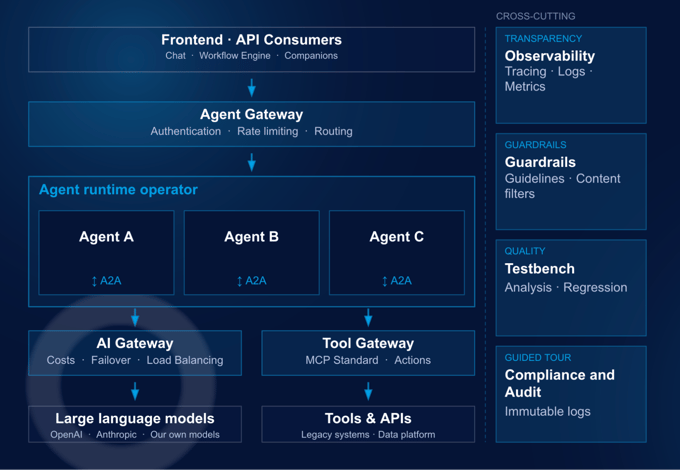
The Three-Gateway Architecture – A Structured Security and Control Model
One of the key insights from our projects is that agents must never communicate with the outside world or backend systems without proper control. For this reason, an Agentic Control Plane provides a clearly separated gateway architecture that decouples access points and governs every data flow. This structure prevents uncontrolled data exchange and provides the level of transparency that is essential in enterprise environments. Without these building blocks, organizations risk creating shadow integrations that are neither maintainable nor auditable in the long term.

1. Agent Gateway – Secure Entry Point and Proxy
Serving as both the technical and organizational entry point ("ingress"), the Agent Gateway is responsible for validating, monitoring, and transforming all incoming requests. Its core responsibilities include:
- Protocol Transformation: It translates between external APIs and the internal A2A protocol used by many agents while managing routing, authentication, and rate limiting.
- Guardrails and Input Security: By inspecting requests for prompt injections, personally identifiable information (PII), and prohibited patterns, it minimizes risks at an early stage.
- Complete Transparency: Through standards-based instrumentation (e.g., OpenTelemetry) directly at the entry point, it prevents the emergence of black boxes and ensures full observability.
2. Tool Gateway – The Compliance Interface for Backend Systems
The Tool Gateway acts as a firewall for sensitive enterprise resources such as ERP and CRM systems, preventing agents from accessing them directly in potentially unsafe ways. Within the Agentic Control Plane, it is responsible for three key areas:
- Fine-Grained Authorization: It centrally defines which agents are permitted to access specific data and tools.
- Policy Enforcement: It automatically enforces security and data protection policies, for example by filtering sensitive information.
- Structured Integration: By leveraging the Model Context Protocol (MCP), it enables controlled and auditable integration between agents and backend systems.
3. AI Gateway – Efficiently Abstracting Model Interactions
By using an AI Gateway, direct communication between agents and specific model providers is decoupled, creating several strategic advantages:
- Flexibility and Interchangeability: Models can be seamlessly substituted without requiring changes to the agents’ program code.
- Centralized FinOps Control: The gateway enables precise monitoring and budgeting of token consumption. A key factor for cost efficiency is the caching of model responses: for identical or semantically equivalent prompts, the gateway serves results from the cache. This leads to a significant reduction in costs while maintaining consistent quality, especially for research-intensive tasks.
- Monitoring and Security: Integrated input and output guardrails ensure that all generated responses are reviewed, sanitized, or blocked in case of policy violations.
- Optimized Routing: Based on criteria such as availability, specific capabilities, or cost, the gateway dynamically selects the most suitable model for each request.
Transparency Instead of Black Boxes – Why Observability Is Essential
One of the greatest challenges in operating autonomous AI systems is their lack of traceability. The Agentic Control Plane addresses this challenge by providing centralized instrumentation across all agents, gateways, and system components. This creates end-to-end observability across every layer, making it possible to trace the decisions an agent has made, understand why those decisions were made, and identify the systems involved throughout the process. For regulated industries and high-risk use cases, this level of transparency is not merely beneficial - it is essential.
Continuous AI Validation as the Backbone of Quality Assurance
Because AI systems are highly sensitive to even minor configuration changes, the Agentic Control Plane incorporates a dedicated testbench. Rather than treating model and agent validation as a one-time activity, it establishes validation as a continuous process. Every modification to prompts, models, tools, or configuration parameters automatically triggers a new set of tests. To effectively detect and prevent gradual quality degradation (regressions), the testbench utilizes a range of evaluation techniques, including LLM as a Judge for qualitative assessment of model outputs.
In this role, the testbench serves as a continuous quality gate that every system change must pass before being deployed.
Protecting Investments Through Flexibility and Openness
A core principle of the Agentic Control Plane is moving away from static architectures. To avoid getting stuck with a specific vendor, the architecture is not tightly coupled to specific frameworks, models, or gateways. Instead, it consistently follows an evolutionary capabilities and plugins approach. This enables individual technology components to be replaced or extended at any time without compromising the overall architectural design.
The result is a highly adaptable system landscape that can respond agilely to changing market conditions while providing organizations with long-term protection for their technology investments.
Preventing Shadow IT with the Agentic Control Plane
Many organizations are currently adopting low-code platforms such as n8n, Flowise, or LangGraph as runtime environments for AI agents. Their ease of use and direct access to enterprise systems make it tempting to combine process logic and agent execution within the same platform. While this approach can deliver impressive results in the short term, it often leads to significant compliance risks, uncontrolled data flows, and architectures that become increasingly difficult to maintain.
The Agentic Control Plane addresses these challenges by enforcing a clear separation of responsibilities. Low-code platforms remain focused on their intended role as workflow orchestrators, while security protocols, model interactions, backend integrations, and agent execution are consolidated within a dedicated technical layer. The result is a structured architecture that enables technological innovation without compromising governance.
Agentic Layer – A Kubernetes-Native Implementation of the Agentic Control Plane
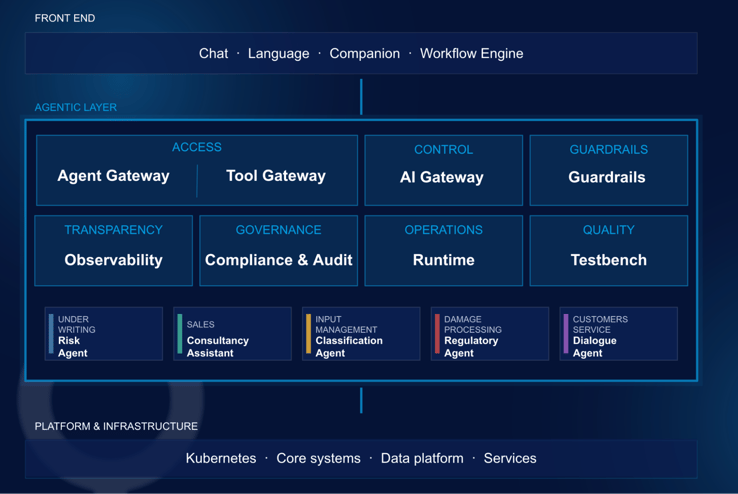
The Agentic Control Plane defines the architectural capabilities required to operate Agentic AI securely and at scale. The Agentic Layer presents one possible Kubernetes-native implementation of this pattern, translating the concept into a concrete, open, and practical architecture. Developed as an open-source project, the Agentic Layer is available as a reference implementation at https://github.com/agentic-layer.
In addition to its Kubernetes-native agent runtime, the Agentic Layer includes the core building blocks of the Agentic Control Plane described earlier, including the gateway architecture for agent, tool, and model access, integrated observability, and mechanisms for continuous AI validation and governance.
The core idea behind the Agentic Layer is that agents should not be treated as a special case, but as regular workloads on a modern container platform. Rather than introducing proprietary runtime environments or tightly coupled frameworks, the Agentic Layer uses Kubernetes as a common operational foundation. As a result, key requirements such as scalability, observability, security, and governance become integral parts of the platform and no longer need to be addressed separately for each agent system.

At the same time, the Agentic Layer follows a consistently framework-agnostic approach. Organizations should be able to develop and operate agents independently of any specific framework, without creating long-term dependencies on particular vendors or technologies. This combination of Kubernetes-native execution, standardized operating models, and technological openness provides the foundation for a sustainable and future-proof Agentic AI architecture.
The Agentic AI ecosystem is evolving rapidly. Frameworks such as Google ADK, LangChain, and Microsoft's Agent Framework emerge and evolve in rapid cycles, APIs change, and new abstractions continue to appear. For this reason, the Agentic Layer deliberately avoids being tied to any single framework. Instead, agents are orchestrated in a Kubernetes-native manner by an Agent Runtime Operator.
The Agent Runtime Operator is responsible for deploying, configuring, and scaling agents as Kubernetes-native resources. It ensures that observability, security policies, and operational standards are applied consistently from the outset, while enabling different agent frameworks to operate under a unified operational model.
Conclusion: Agentic Excellence Requires a Solid Architectural Foundation
The emergence of AI agents represents a fundamental shift in enterprise IT. Through their autonomous behavior, decision-making capabilities, and access to sensitive data, agents interact directly with business processes. While this creates significant opportunities for organizations, it also raises the bar for security, governance, compliance, and cost control. Without a robust architectural foundation, organizations risk creating shadow IT, new data silos, dependencies on individual vendors, and operational risks that are difficult to manage.
The Agentic Control Plane provides a systematic architectural approach to addressing these challenges. It enables organizations to bring agentic systems into production in a controlled, scalable, and secure way - without sacrificing sovereignty over their infrastructure, models, or data.
As a practical Kubernetes-native implementation of this concept, I introduced the Agentic Layer. This open-source project demonstrates how the core principles of an Agentic Control Plane can be realized in a future-proof, extensible, and technology-agnostic way.
Our vision is to make Agentic AI controllable - and therefore manageable. Only a technical foundation that supports audits and provides full control can enable the transition from prototype to enterprise-grade solution. The Agentic Layer is our contribution to this goal: an intentionally open and lightweight building block for the future.
Written by
Mario-Leander Reimer
is a Managing Director / CTO at QAware. He is a specialist in the design, implementation, and operation of distributed system and software architectures based on open-source components. He is [...]