5 min read
Why 80 % of AI projects fail and why a platform strategy is the only way out
The reality of AI transformation is sobering. Although proofs of concept often deliver impressive results, Gartner reports that 80% of all AI initiatives fail en route to productive deployment. The reasons for this failure rarely lie in the models themselves, but rather in a lack of architectural maturity and organisational embedding. Anyone looking to scale up AI must stop creating patchwork solutions and start thinking in platforms.
The current hype surrounding generative AI and agentic workflows tempts companies to prioritise achieving quick results. Developers copy data onto laptops, build demos in Python notebooks or assemble complex logic using low-code tools. This approach works perfectly well for initial results. However, as soon as these solutions are expected to scale, they encounter the final 20% hurdle: the remaining 20% required for a production-ready solution accounts for the majority of the work, costs and complexity.
Investing in architecture means investing in business value
Investing in building or integrating a solid platform architecture does not generate immediate business value, but it does generate sustainable value. The arguments for this strategic step are compelling:
- Reduction of cognitive load: Development teams often become overwhelmed by complexity because they have to master security, infrastructure, prompt engineering and business logic simultaneously. A platform addresses cross-cutting concerns centrally, enabling teams to focus on creating actual value again.
- Compliance and risk minimization: Compliance with data protection regulations, such as the EU AI Act and GDPR, cannot be limited to mere paperwork. A platform can enforce security policies such as the filtering of personally identifiable information (PII) and provide audit-proof logging.
- Investment protection and flexibility: AI technology is evolving rapidly. A decoupled architecture prevents vendor lock-in. This means that models and clouds can be replaced without the need to reimplement business logic.
- Standardization instead of shadow IT: A central platform prevents business units from exposing core systems to the internet without protection just to connect them to SaaS tools via API.
The problem: The Big Ball of Agentic Workflow Mud
Without this strategic foundation, a dangerous pattern is currently emerging in many companies. Business units and IT departments are implementing AI agents directly within workflow engines or frameworks, which tightly integrates business logic, backend integrations and LLM calls.
This tightly coupled design leads to an unmaintainable state, which we refer to as the 'Big Ball of Agentic Workflow Mud'. Consequences include a lack of governance, security gaps caused by uncontrolled data flows and massive dependency on volatile technologies.
The solution: Establishing an Enterprise AI Platform
Rather than more standalone tools, companies need an AI platform architecture to manage this complexity. Such a platform acts as a control plane for intelligent workloads, bridging the gap between the unstructured world of LLMs and the structured world of enterprise IT.
A modern AI platform should be capable of more than just hosting containers. It must fulfil the following architectural requirements:
- Secure backend integration and data access: Access to internal systems such as CRM or ERP by AI agents must not be hardwired. Instead, it requires a defined interface, such as an MCP gateway, to ensure that an agent can only perform the actions it is authorised to execute. The data foundation is equally critical: the platform must centrally organise access to clean, internal and external data via a data lake or warehouse, as missing or poor-quality data is the most common cause of failure in AI projects.
- Comprehensive observability and audit logs: Black box behaviour is unacceptable in enterprise environments. The system must provide in-depth analysis of the AI's reasoning processes. Complete audit logs and end-to-end tracing, such as that provided by OpenTelemetry, enable full traceability of every agent decision.
- Integrated test bench: Quality assurance cannot be left to chance. An integrated testing environment enables the systematic validation of LLMs and agents before productive deployment, for example using LLM as a judge, in order to immediately detect regressions when models are updated.
- FinOps and infrastructure scaling: Cost control is essential when using LLMs with a pay-per-token model. The platform must monitor budgets and enforce limits if these are exceeded. At the same time, the underlying infrastructure — particularly the expensive GPU resources — must be able to scale dynamically in order to handle peak loads and minimise costs during idle periods.
- Error handling and human in the loop: AI is not infallible. The platform must therefore provide mechanisms to intercept critical decisions or uncertain agent actions, and direct them to a human for review. This prevents reputational damage and enables the platform to be used in sensitive business processes.

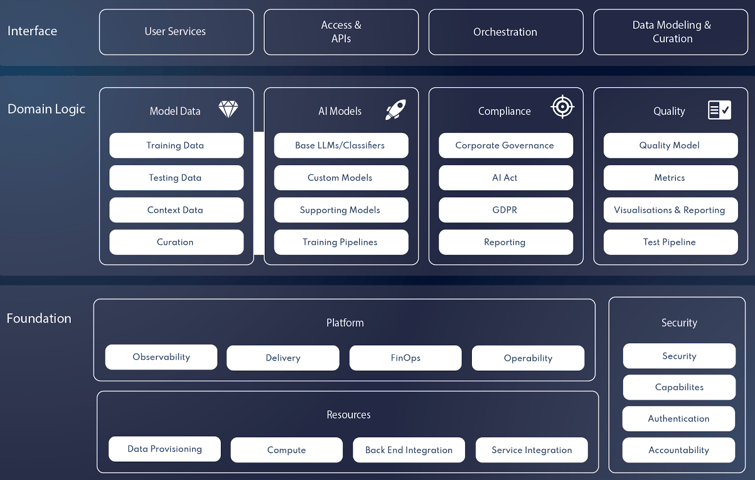
As illustrated by the architectural blueprint, such a platform must be clearly structured into layers to ensure that responsibilities are kept separate.
The interface layer serves as the interaction layer for different stakeholders.
- User services provide domain experts with convenient, low-code user interfaces that allow them to easily create chatbots or RAG applications.
- Access and APIs offer various APIs, for example for LLMs or embedding models, enabling software developers to build individual AI workloads.
- Orchestration enables the orchestration of workflows, scaling, instantiation, and configuration of AI components.
- Data Modelling enables the definition and management of semantically usable models so that agents, models, APIs, and orchestration can work together seamlessly.
The domain logic layer contains the core functions of the platform.
- Data plane is crucial for the efficient handling of data. Its primary functions are the efficient ingestion of large volumes of data and versioning through data management. It also provides advanced search capabilities, such as semantic search and Retrieval-Augmented Generation (RAG), by computing data embeddings and leveraging specialised databases, such as vector or graph databases, for semantic search and RAG.
- Model layer is the central component for managing AI models throughout their entire lifecycle. Its key functions include providing a central model registry, tracking experiments to compare different model versions or types, managing models to control their lifecycle from selection to maintenance, and deploying models as part of MLOps.
- Quality plane is responsible for evaluating the quality and impact of AI solutions on customer facing use cases. Key metrics include technical performance indicators such as accuracy, reliability, harmfulness and confidence, as well as business KPIs. To account for the inherent unpredictability of AI-generated content, this layer incorporates robust test automation.
- Compliance plane contains components that ensure adherence to regulatory and internal requirements, particularly with regard to data protection, security, and the appropriate tone of all content generated.
The foundation layer encompasses the traditional and cross-functional operational elements necessary for the stable operation of AI workloads.
- Platform plane is based on four pillars: provisioning through CI/CD and registries for automated deployment, observability through monitoring logging and tracing for both AI specific and general operational aspects, operability including scaling backup and recovery, and FinOps for continuous cost monitoring and management.
- Security plane manages passwords, identity (IAM), encryption, and certificate management.
- Resource plane is responsible for providing the necessary technical resources. It includes computing infrastructure such as CPU and GPU capacities and storage services, as well as the seamless integration of managed AI services or other resources provided by the cloud provider.
Risk Management as a Service
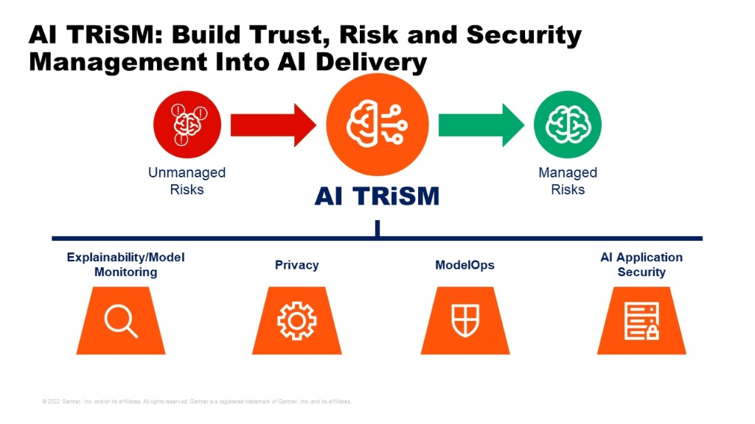
New technical innovations always introduce new risks. This also applies to AI, of course, and experience to date has shown that traditional security approaches are ineffective. Gartner summarises this concept as AI TRiSM (Trust, Risk and Security Management).

An AI platform is the organizational and technical vehicle to implement AI TRiSM. As the graphic illustrates, the platform transforms unmanaged risks into managed risks.
- Explainability: Through observability, model behavior becomes explainable.
- Privacy: Through centralized guardrails, data protection violations are proactively prevented.
- ModelOps: The lifecycle of models is professionalized and automated.
- Application security: Security vulnerabilities in agents and the associated blast radius are minimized through standardized gateways and testing.
Technology is not everything: The human factor and culture
Although a robust technical platform is important, it alone does not guarantee success. The introduction of agentic AI necessitates a cultural shift. Future users must be involved and trained from the outset to foster acceptance and address concerns, such as those relating to job security. Ultimately, a platform that nobody uses generates no value. Therefore, strong change management must always accompany the technical introduction.
However, even if an organisation tries its best, another important factor is needed to achieve a high level of acceptance within the company: an excellent developer experience (DevEx). A platform provides little benefit if the non-functional requirements of internal teams are not adequately considered. Developer experience means that every stakeholder, from software developers and testers to site reliability engineers, receives the appropriate tools and workflows — such as clear software development kits (SDKs), integrated testing environments and automated GitOps pipelines — to create value efficiently and without frustration. The platform therefore acts as both a technical foundation and an enablement layer, maximising platform adoption and bringing innovation into production quickly.
Conclusion: From Experiment to Excellence
Prototypes are easy; production is hard. Anyone who views agentic AI as a strategic tool for increasing productivity and quality, rather than just a playground, must professionalise the underlying infrastructure. Simply building agents is not enough. They must also be orchestrated, secured, and managed.
The solution to the 'Big Ball of Mud' problem is clear architectural separation.
But how can these architectural requirements be technically implemented without reinventing the wheel? In my next article, I will present a concrete, Kubernetes-native reference architecture that solves this problem. I will introduce the Agentic Layer, a lightweight add-on designed specifically for this purpose.
Written by
Mario-Leander Reimer
is a Managing Director / CTO at QAware. He is a specialist in the design, implementation, and operation of distributed system and software architectures based on open-source components. He is [...]